
Tales of Nimoria · Ariaborn Compendium
Vistora
An ancestry of fungal origin, split between the subterranean Myconids and the sun-seeking Selphins.
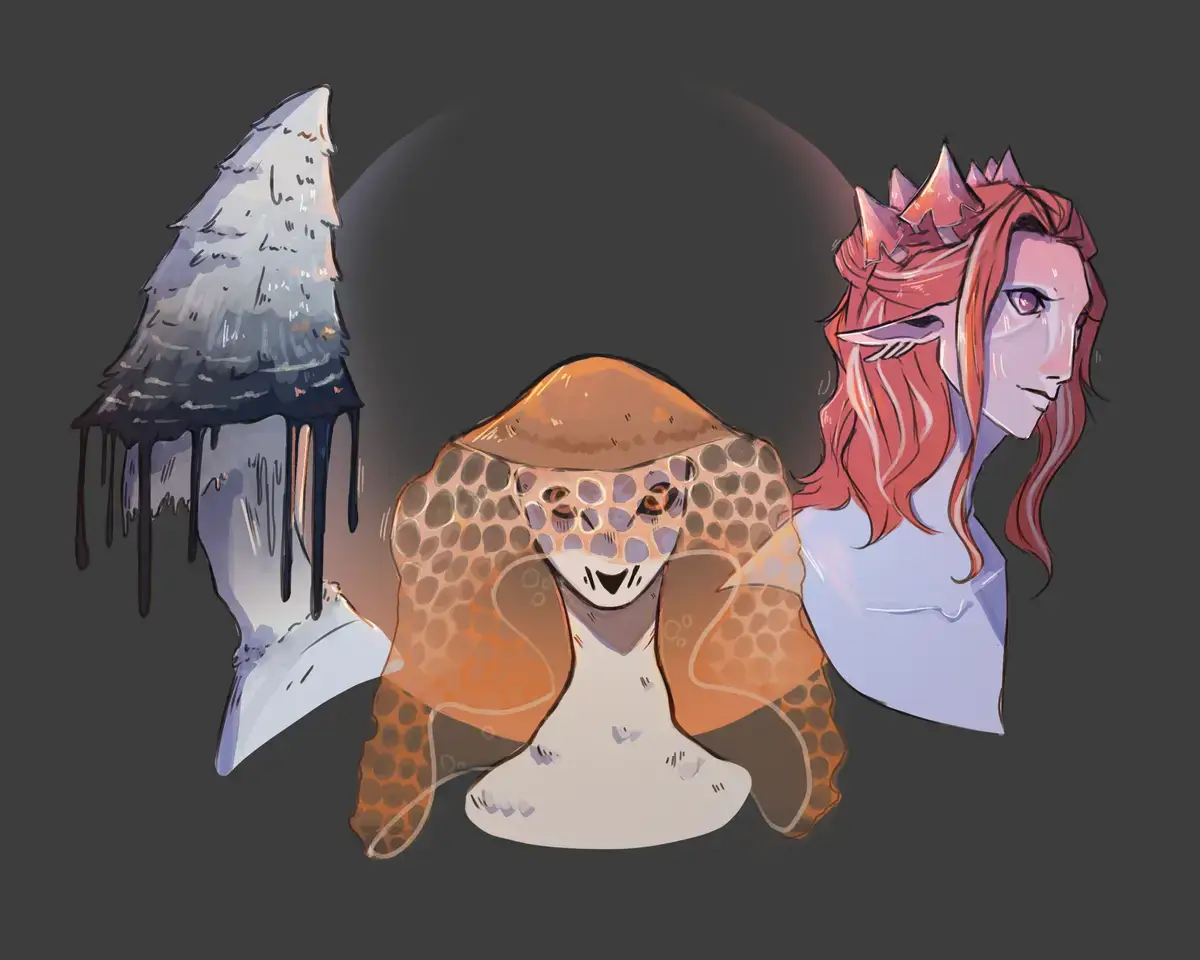
"Their macabre ways of honoring life and death is something many of us will likely never understand. And yet, there is a faint, almost grotesque beauty to be found in their darkness."
Vistora
PLACEHOLDER
- Overview
- Character Creation
- History
- Physiology
- Reproduction & Life Cycle
- Height, Build & Senses
- Society & Culture
- Isolation & Companionship
- Myconid & Selphin Temperaments
- Diet
Overview
The ancient Vistora, an ancestry originally consisting of the fungal Myconids, evolved into sentience through countless eons of their existence away from the surface dwellers living hundreds of miles above the earth.
Upon the discovery of the surface, a subsect of the Vistora, the Selphins, rose alongside their Myconid cousins with their chloroplast skin and petal-adorned heads.
While many remained below ground, select groups found themselves attracted to the bright skies that illuminated the overworld. At first, those who made the trek found it only suitable to thrive in decay-filled areas similar to their homeland, but some wished to transcend this, seeking guidance from the sun they revered so much.
The Selphins' separation from their Myconid cousins, combined with their rejection of the gloom and isolation that dominated much of their societal values, has caused a great rift to form between the two Vistora. When an outsider is asked their opinion on the matter, all questions tend to devolve to a single notion; would you choose to cloak yourself in the safety of the darkness, or would you throw yourself at the mercy of the light?
Character Creation
Lorem ipsum dolor sit amet, consectetur adipiscing elit, sed do eiusmod tempor incididunt ut labore et dolore magna aliqua. Ut enim ad minim veniam, quis nostrud exercitation ullamco laboris nisi ut aliquip ex ea commodo consequat.
Vistora tend to lack nostrils or mouths, with eyes being the only sensory organ present despite a few being born without eyes anyway. Their senses are largely dictated by the spores they release, being used to process stimuli and communicate with others as they lack vocal cords. The sizes of their heads are quite large to ensure sufficient spore range. They will also use a variety of materials to create skeletal systems to mimic the shapes and statures of kalmenids such as sticks, stones, animal bones, etc.
Vistora are generally in the same height ranges, averaging between 3'2 to 5'9, although Selphins are found to typically be the taller of the two subraces due to their sunlight-driven functions. Their weights are often proportional to their heights, ranging from 32 to 155 pounds on average. Their builds are generally stout or skinny, with Myconids being a tad stockier than Selphins and vice versa.
They need just over 20 years in their uprooted stage to reach adulthood. While Vistora have been known to live for extremely long periods of time before their arrival to the surface, this was only possible through their direct connection to their mycelium. Because they have evolved to uproot themselves, they do not live indefinitely, reaching expiration at 100 years.
History
Thriving in the corners of the deep, damp darkness of the Undergrowth lived the ancient Vistora; an ancestry originally consisting of the fungal Myconids, having evolved into sentience through countless eons of their near-invisible existence away from the surface dwellers living hundreds of miles above the earth.
While many remained below ground, a few select groups found themselves attracted to the bright skies that illuminated the overworld in its radiance. At first, those who made the trek found it only suitable to thrive in decay-filled areas similar to their homeland, but some wished to transcend this, seeking guidance from the sun they revered so much. Through many years of adapting to their new environment, this sect of Vistora became known as Selphins, defined by their now floral, plant-like features.
Physiology
Vistora are a diverse ancestry that originally evolved from the vast taxonomic kingdom of fungi, differentiated by the name, Myconid, having ruled over their native home of the Undergrowth before they evolved into basic locomotion and even the far later creation of man. They were defined by their ability to decompose organic matter for the continuance of the cycle of life, releasing spores to both communicate and reproduce. This remained until the migration of the now-called Selphins to the overworld, whose evolution was fostered by the discovered ability to form symbiotic relations with plantlife.
Before being able to produce their own food, early Selphins rejected their decomposing nature and instead sought to interlink themselves with the root cells of plants, offering these plants more resistance to harmful environmental forces in exchange for the sugars formed through photosynthesis. Eventually, the Selphins fully grew into their host plant of choice during the early stages of their life, allowing the chloroplasts to intimately combine with their own cellular makeup. This allowed them to fully mimic the biological functions of a plant, albeit not quite straying from their fungal origins.
Reproduction & Life Cycle
Both Vistora, Selphins and Myconids, are born from spores, germinating into thin threads of hyphae until compatible strands form a network of mycelium. Vistora can remain in this stage of life for many years depending on environmental factors, either interlocking with a host plant in a sunlight-rich area or absorbing the nutrients of a dark area's soil before their cue to fruit comes to be. During this point, Vistora have limited consciousness, not too unlike fetuses in the later stages of gestation. Once a Vistora begins to fruit, it will take them many months for them to separate from the ground, as their physical characteristics still need time to fully develop.
After this has happened, they are biologically considered children, needing just over 20 years in their uprooted stage to reach adulthood. While Vistora have been known to live for extremely long periods of time before their arrival to the surface, this was only possible through their direct connection to their mycelium. Because they have evolved to separate themselves from it at birth, they do not live indefinitely, reaching expiration at 100 years.
Height, Build & Senses
Vistora are generally in the same height ranges, averaging between 3'2 to 5'9, although Selphins are found to typically be the taller of the two subraces due to their sunlight-driven functions. Their weights are often proportional to their heights, ranging from 32 to 155 pounds on average. Their builds are generally stout or skinny, with Myconids being a tad stockier than Selphins and vice versa.
They also tend to lack nostrils or mouths, with eyes being the only sensory organ that is commonly shared with other races, despite a few Vistora being born without eyes anyway. This is because their senses are largely dictated by the spores they release, being used to process stimuli and communicate with others. The sizes of their heads, often appearing visually similar to fungi or flowers, are quite large to ensure sufficient spore range.
Society & Culture
Lorem ipsum dolor sit amet, consectetur adipiscing elit, sed do eiusmod tempor incididunt ut labore et dolore magna aliqua. Ut enim ad minim veniam, quis nostrud exercitation ullamco laboris nisi ut aliquip ex ea commodo consequat.
In the beginning, Vistora lived in vast hiveminds together in an underground world that they call the Undergrowth, a name shared almost exclusively among themselves to refer to the secretive, cavernous lands lying underneath the surface. The age of fungal empires came to pass, however, as soon as Vistora began to evolve into learning individuality and exploring the world beyond themselves. This indirectly caused the great divide between the Myconids and, their newly-formed cousins, the Selphins from the moment they discovered the light of the overworld.
The separation of the Myconids and Selphins are felt through their radically different approaches to envisioning the cycle of life; a driving concept behind their very existence. The Myconids believe that the death of something is, essentially, its rebirth, able to share and fulfill the legacy of the life it lived before and so on. The Selphins, on the other hand, believe that death is the end of all that lives, and that it marks the beginning of something entirely new. The conflicting ideas of continuity versus finality were what caused a rift between the two subraces in the first place, owed also to their newfound physical differences.
Isolation & Companionship
Generally speaking, Vistora are isolationists that do not find a biological need to form societies of their own and often find it more suitable to thrive alone, sometimes only forming groups out of sheer coincidence or necessity. Companionship for a Vistora is typically found in the gardens or farms they create for themselves, either consisting of plants, fungi, animals, or even just decaying matter, being the emotional equivalent of raising a family for any other ancestry. In this way, they fulfill their need to intermingle with the forces of nature, contributing to it. However, it is not uncommon for Vistora to find themselves accustomed to forming connections with other individuals, or perhaps deciding not to homestead at all for one reason or another.
Myconid & Selphin Temperaments
In terms of their attitudes, Selphins tend to be more lively than Myconids due to their exposure to surface-dwelling ancestries. Many find themselves assisting in education and social services due to this fact. Myconids are found to be more reclusive and often dwell in silence away from others, but these traits tend to find usage elsewhere in social settings. For example, Myconids are found to be quite useful in funerary homes and libraries for their quiet and thoughtful natures. What both Vistora have in common, however, are their knowledge of medicine and herbology, finding equal place in apothecaries, farmlands, and clinics.
Diet
The diet of Vistora is largely different from most, deriving nutrients from soil, sunlight, or a combination of both. However, this does not restrict them to eating plants and meat on a typical dinner plate, only making it a bit difficult and awkward for them to go through their digestive processes. To eat something outside of their usual, a Vistora needs to maintain contact with the foodstuff through skin, where hyphae may sprout forward and slowly release enzymes to break it down into digestible nutrients that they can then absorb into themselves. This can take a relatively long time depending on the meal, as heavily processed foods can break down rather easily.