
Tales of Nimoria · Ariaborn Compendium
Kalmet
A truly cosmopolitan people, descended from the last major migration out of Kalmeros.
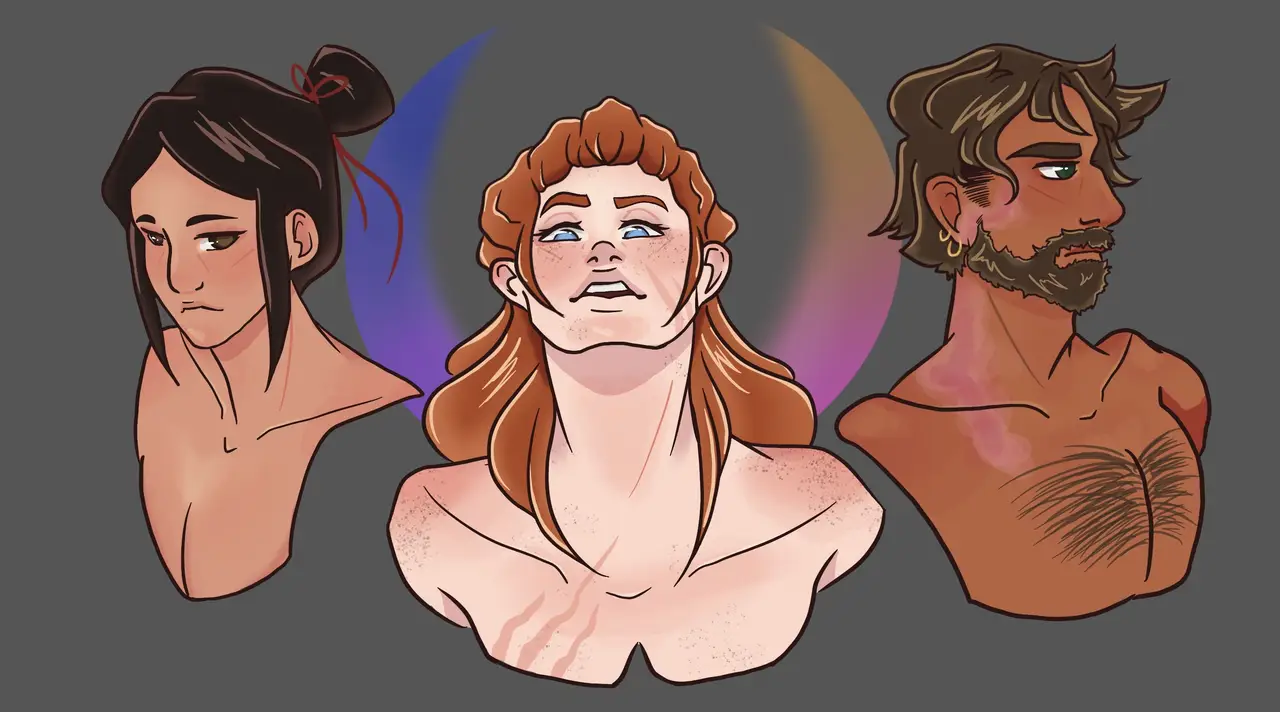
"You've wandered for millennia, and may yet wander still. And if your journey ends in a place unknown, child of Kalmeros, you'll be welcomed all the same."
Kalmet
PLACEHOLDER
- Overview
- Character Creation
- History
- General Physiology
- Global Palette
- Society
- Diet
Overview
With their truly cosmopolitan reach, it's difficult to believe that Kalmet descend from the last major migration out from Kalmeros.
Being commonplace, they are often cited as a benchmark for the mundane, even among their Kalmenid cousin. It is this capacity to wander and adapt however, that marks them as unique in their own right.
Character Creation
Lorem ipsum dolor sit amet, consectetur adipiscing elit, sed do eiusmod tempor incididunt ut labore et dolore magna aliqua. Ut enim ad minim veniam, quis nostrud exercitation ullamco laboris nisi ut aliquip ex ea commodo consequat.
Kalmet typically stand between 163–180 cm in height, though individuals reaching up to 193 cm are not unheard of. Their builds vary widely, from lean to broad, reflecting the immense environmental and cultural diversity of Kalmet populations. Sexual dimorphism is present but moderate, most often expressed through differences in average height, musculature, and fat distribution.
Kalmet appearance spans a vast global palette. Skin tones range from very pale to deep brown and near-black, often reflecting ancestral homelands and long-term exposure to sunlight. Hair textures and colors vary just as widely, from straight to tightly coiled, and from light blondes and reds to deep browns and blacks. Eye colors are similarly diverse, with browns being most common, alongside greens, blues, and rarer hues.
Kalmet reach adulthood between 18–25 years and typically live 70–90 years, though this varies significantly with environment, lifestyle, and access to resources. They are obligate omnivores, requiring a balanced intake of plant and animal matter, though individual cultures may lean heavily toward pastoral, agricultural, foraging, or mixed subsistence strategies.
Culturally, Humans are highly adaptable and socially inclined. Small communities tend to be egalitarian and communal, while larger societies often develop hierarchical or stratified systems. This flexibility—social, cultural, and environmental—is widely regarded as humanity's defining trait among the Kalmenids.
History
Speculation abounds on the origins of the Kalmenids—those beings commonly known as Kalmet, Héroska, Anden, and Floren. But metaphysical explanations aside, it is the current opinion of the Assembly that all Kalmenids are, despite what some groups insinuate, of the same stock, if far removed in some cases. In the case of Kalmet, given that their offspring are more regularly successful, the Assembly surmises that the Floren are more closely related to Humans than either are to the Dalro or Yranden.
The origins of the Kalmet as a whole are still intensely debated, but scholars of the Assembly generally agree that the Kalmet further share origins with those creatures commonly referred to as primates.
As with their kin, Kalmet are generally believed to have come from the continent of Kalmet, where some of the oldest settlements still reside. Unlike their kin, however, Kalmetian advance across Yoren has far from reached its end. (See migration map for details.)
General Physiology
Like most other kalmenoids, Kalmet are upright, bipedal sophonts. They have dexterous, articulate hands and digits which are used for everything from the acquisition of food to the making of complex tools.
While less drastic compared to other species, Kelmet do exhibit sexual dimorphism, but it can be generally said that, across this ancestry, they range in height from 163 to 180 cm. Some have even been documented reaching heights up to 193 cm.
Kalmet exhibit a rather profound degree of diversity in appearance spread across Yoren. This diversity is one of those traits that sets them apart from other members of House Kalmet.
Global Palette
Their broad reach has borne immense diversity, with the most obvious distinctions manifesting themselves in the myriad hair, skin and eye colors across the global Kalmet population.
While not an exact science, it can be taken for granted that, depending on where a Kalmet hails from, their skin will bear a particular shade. Those further away from intense annual sunshine tend to exhibit paler tones, obviously in contrast to the darker tones of those indigenous to the sunnier climes.
Indeed, the range of hue from pallid to pitch is staggering and is made further complex by the nature of the color within a given range (the difference between a cool and warm shades, for instance).
Society
Lorem ipsum dolor sit amet, consectetur adipiscing elit, sed do eiusmod tempor incididunt ut labore et dolore magna aliqua. Ut enim ad minim veniam, quis nostrud exercitation ullamco laboris nisi ut aliquip ex ea commodo consequat.
Given the size of their population and scale of their expansion, it is difficult to make universal generalizations regarding their social structures. However, some commonalities can be ascribed.
As with all Kalmet, and to a lesser degree all kalmenoids, Kalmet are immensely social, seemingly preferring to live in groups of at least 40 individuals or more. These groupings on the smaller scale, referred to as bands by the Assembly are exceedingly egalitarian. Childcare is often communal, one of many attributes that point to these smaller groupings being more communal on the Communal-Individual spectrum.
Of course, this communal behavior begins to give way to more individualism as the scale of a given Kalmet settlement grows. Indeed, those large groups with resource abundance tend to favor some form of hierarchy and stratification. Generally speaking, communal behavior is still attested in communities within a larger groupings, but that society as a whole can be said to be more individualistic.
All told, Kalmet run the gamut in diversity of societal structure, but tend toward egalitarianism where it's feasible, even within larger societal groups where individualism is considered more the norm.
Diet
As you will have likely discerned from previous sections of this dossier, Kalmet are too numerous to speak in certainty on them. This holds true for their diet as well.
They can be said to be obligate omnivores; their bodies requiring a mixture of meats and plant matter in order to operate efficiently. In most sedentary societies, grains comprise a significant portion of the diet, supplemented by meats afforded through husbandry.
In those societies where foraging is still the main source of subsistence, it can be said that fruiting plants, fungi and small game comprise the main forms of sustenance, with large game supplementing where it can be obtained.
There again, the largely nomadic, pastoral societies in the northern steppes of Estera primarily live off of their herds and supplementing with what little can be foraged among the steppe.
So, Kalmet can be said to be omnivores generally, but one will find among them a variety of subsistence strategies along the spectrum between carnivorous and herbivorous.